
Showing posts with label Real Estate Fundamentals. Show all posts
Showing posts with label Real Estate Fundamentals. Show all posts
Monday, March 22, 2010
Competition Bureau VS MLS - What each side is doing
Canadian Real Estate Association (CREA) feel they've bent over backwards by offering the following:
- Giving clients access to market their property on MLS without having to hire an agent for the entire period of time the home is listed.
- The individual real estate boards can make their own rules how consumers can list using the MLS
The Competition Bureau says this is not good enough, they want:
- Real estate agents to give consumer more options when selling their home for clients
- A uniform strategy across all boards across Canada (easier to monitor and police)
- More options to sellers when having a buyers agent approach them with clients
The Competition Bureau is an independent law enforcement agency that contributes to the prosperity of Canadians by protecting and promoting competitive markets and enabling informed consumer choice.
Next step, it looks like the Competition Bureau will take CREA to the Competition Tribunal to come to some sort of resolution
My view: 50/50
On one had, there are already so many crappy agents out there who barely know to write a listing, how much worse will it come when you get non-professional people preparing listings and handling negotiations.
On the other hand, it does make things cheaper for me when I decide to sell a property.


Tuesday, December 15, 2009
Graphical Representation of US Bubble by BBC
The US sub-prime mortgage crisis has led to plunging property prices, a slowdown in the US economy, and billions in losses by banks. It stems from a fundamental change in the way mortgages are funded.

Read full article here
Tuesday, December 8, 2009
Is this a bubble? - Comment on TD Housing Outlook

TD bank recently published a Resale Housing Outlook report (see here)
TD comments if the real estate market is in a bubble.
Conclusions:
- On a national level, they feel that prices are overvalued 12% based on market fundamentals (income growth, job growth etc).
- Most of pent up demand from the sales crash last year should be clear by now
- From next year on, we should see the real estate market return to growth based on fundamental drivers (or have price growth slow to catch up to the fundamentals since incomes are expected to go up).
- They don't expect prices to fall, in fact their fear is prices may continue to rise.
Real Experts Comment: Yes the market overshot, and people have been taking advantage of rates to get into the market. As more supply comes online in the market (finished condos, and new listings) and as supply of buyers capable buyers fall, prices should level off to a lower growth rate.
As of today, this is no bubble.
Monday, May 11, 2009
New home prices edge lower - Western cities post largest drops, Statscan says
My Response to the comments on the latest globeandmail article
Why is western Canada taking a bigger housing hit when Ontario has lost more jobs.
Taking a look at prices at a historical level we have seen the market appreciate at incredible levels since 2005. It’s hard to put in context that the Tiger Wood’s like years we have been having is not the norm. The home prices shot up too quickly because of the frenzy of buying since 2006. We are seeing a normal correction in a long term up cycle.
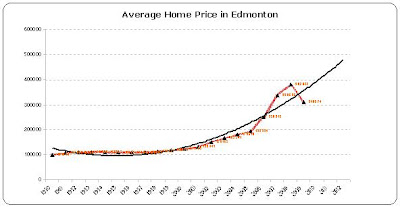
We need to get back to late 70's house prices for it to match peoples ACTUAL paychecks these days. Till then oh well, the price crash has just started.
Affordability of a home is a key measure of the health of the market. According to the RBC affordability index, which measures the average pre-tax income that goes towards housing, Edmonton is currently under 40%. This is at the historical norm. It should be taken into account that the affordability now is even better than it was over the past 20 years with the introduction of the 35 amortization mortgages.

Why is western Canada taking a bigger housing hit when Ontario has lost more jobs.
Taking a look at prices at a historical level we have seen the market appreciate at incredible levels since 2005. It’s hard to put in context that the Tiger Wood’s like years we have been having is not the norm. The home prices shot up too quickly because of the frenzy of buying since 2006. We are seeing a normal correction in a long term up cycle.

We need to get back to late 70's house prices for it to match peoples ACTUAL paychecks these days. Till then oh well, the price crash has just started.
Affordability of a home is a key measure of the health of the market. According to the RBC affordability index, which measures the average pre-tax income that goes towards housing, Edmonton is currently under 40%. This is at the historical norm. It should be taken into account that the affordability now is even better than it was over the past 20 years with the introduction of the 35 amortization mortgages.

Wednesday, May 6, 2009
Cash Is King – The Power of Positive Cash Flow
Today, I would like to illustrate the importance of positive cash flow in real estate investing. As I mentioned in previous articles, positive cash flow is a key element in real estate. Positive cash flow is important because it can allow you to make money in any real estate market – even during times when real estate prices are going down. However, please note that positive cash flow is not the only criteria when considering real estate opportunities, however, it is one of the tools used to identify good investment properties.
At Real Experts Inc, we generally purchase positive cash flow properties. At a minimum, we would consider buying properties that breaks even now, but have the potential to generate positive cash flow in the future. Let me illustrate the power of having positive cash flow properties in your investment portfolio and impact it can have on your investment returns.
About one year ago, I purchased a property in a small town in Ontario for $88,900 (a triplex). The price might shock you because it seems very low, but trust me; this is a real deal that I have completed. My total out of pocket cash investment was $11,800 – this includes the 10% down payment and closing costs. The monthly positive cash flow on this property is $400. ($4800/year). Therefore, my total return on my investment is 40.6%/year! If you think that is a great return on anyone’s money, you would be right. Now keep in mind, my return figure does not include any price appreciation or the fact that I was able to purchase this property below market value. But at the end of the day, with great cash flow like this, who’s counting on the real estate market to go up? Now, deals like this are not easy to find and it takes a lot of time and research to spot the right areas, and negotiate a favourable price.
Following a strategy of only buying cash flow positive properties, below current market values, has allowed us to make money even in today’s soft real estate market. In closing, positive cash flow is a very important element in real estate investing and can deliver key benefits such as:
a) Stable returns month after month (if the property is managed right and has no vacancies)
b) Allow you to generate profits even in down markets, thereby allowing you to ride out any short-term downturns such as the one we face now.
c) Reduce risk and generate the cash you need to purchase more real estate in the future.
At Real Experts Inc, we generally purchase positive cash flow properties. At a minimum, we would consider buying properties that breaks even now, but have the potential to generate positive cash flow in the future. Let me illustrate the power of having positive cash flow properties in your investment portfolio and impact it can have on your investment returns.
About one year ago, I purchased a property in a small town in Ontario for $88,900 (a triplex). The price might shock you because it seems very low, but trust me; this is a real deal that I have completed. My total out of pocket cash investment was $11,800 – this includes the 10% down payment and closing costs. The monthly positive cash flow on this property is $400. ($4800/year). Therefore, my total return on my investment is 40.6%/year! If you think that is a great return on anyone’s money, you would be right. Now keep in mind, my return figure does not include any price appreciation or the fact that I was able to purchase this property below market value. But at the end of the day, with great cash flow like this, who’s counting on the real estate market to go up? Now, deals like this are not easy to find and it takes a lot of time and research to spot the right areas, and negotiate a favourable price.
Following a strategy of only buying cash flow positive properties, below current market values, has allowed us to make money even in today’s soft real estate market. In closing, positive cash flow is a very important element in real estate investing and can deliver key benefits such as:
a) Stable returns month after month (if the property is managed right and has no vacancies)
b) Allow you to generate profits even in down markets, thereby allowing you to ride out any short-term downturns such as the one we face now.
c) Reduce risk and generate the cash you need to purchase more real estate in the future.
REAL ESTATE IS A PROFIT MACHINE! - 7 Ways To Profit from Real Estate
As a sophisticated investor, I review every aspect of an investment before jumping in. The top 3 things I study are how the investment will be profitable, the risks involved and possible exit strategies.
Today, I like to focus on how investment in real estate can generate profits. Now most of us already know the 2 main ways real estate generates a profit – increase in property value (appreciation) and positive cash flow. However, did you know that there are 5 additional ways real estate can put money in your pocket? If your answer is “No”, please keep reading and you will be amazed to learn that there are actually 7 ways to make a profit in real estate.
Folks, only after learning that real estate can be profitable this many ways, I was able to come to the decision that real estate was an investment that I should be involved in.
1. The first one is Equity. Equity is basically the current market value of a property minus the mortgage amount owed to the bank. So how do you increase equity and therefore your profit on your real estate? When buying, you can negotiate and secure a lower purchase price (below fair market value) and when selling, you may be able to get top dollar for your property. If you do both things correctly, you can make thousands of dollars in profit. I will discuss ways to accomplish both in another article.
At Real Experts Inc, buying below current fair market value is a cornerstone of our strategy and so we always try to find deals at a discount. All of our properties have been purchased at least 10% below market. In today’s market, if you do your homework, you can find deals like that in many places – just make sure those areas are growing and have good long-term prospects.
2. Leverage is the power of using the bank’s money to fund your real estate purchases. By using the bank’s money to fund the majority of the property’s purchase price, you can now buy more property. Let me give you an example. Let’s say you have a $100,000 in cash to invest and there is a property that you would like to buy, also worth $100,000. Now you have two options:
a) Use all of your money to fund this purchase or
b) Use the bank’s money to fund the majority of this purchase and very little of your own money.
So now let’s look at the impact of both of these strategies:
a) If you use all of your money to buy this $100,000 property, you’ve bought 1 property with no debt but now you have run out of money to invest in other properties!
b) If you go and get a mortgage with the bank, say for 80% of the purchase price ($80,000) and pay the rest yourself 20% ($20,000), you have only spent $20,000 of your cash. This leaves you with another $80,000 to invest in other properties!
One word of caution, if you are borrowing from the bank, make sure that your property generates enough monthly rent/income to cover the mortgage payment as well as all the other costs (property taxes, utilities, insurance, property management fees etc).
3. Appreciation simply refers to the increase in market price of your property. Based on conservative estimates, real estate has appreciated an average of 3-5%/year over the past 25 years. So does that mean you’ve only made 3-5% on your investment? Absolutely not!
Let me illustrate an example. Say you purchased a property worth a $100,000 and made a down payment of $10,000 and financed the rest with a mortgage from the bank. Your actual out of pocket investment is only $10,000. Let’s also assume that the property went up in value by 5%. What’s your return on investment? Well it 50%!
How is this possible? Well, if you take the increase in property value which is $5000 (5 % x 100,000) and divide it by your out of pocket investment $10,000 this equals 50%. This is the power of appreciation and leverage in real estate!
4. Principal Reduction. This is one of the sure fire ways to make money in real estate. Every month you are going to be collecting rent from your tenants. You will use that rent to pay your monthly mortgage bill. As we all know, part of your mortgage payment goes towards the interest on your loan, but the other part goes towards the principal amount that you owe. So this means you have now got someone else paying down your loan and in time your mortgage balance will be zero!
5. Positive Cash Flow. Positive cash flow simply means that your total income on a property is greater than all the expenses related to that property. Positive cash flow is a key fundamental in real estate investing. You only want to purchase property that is positive cash flow. At a minimum, you want to make sure that the property breaks even and that you don’t have negative cash flow.
All of our properties generate positive cash flow and have allowed us to live a better lifestyle and not rely on a company pay cheque all the time. In most cases, positive cash flow coupled with principal reduction of your mortgage is your ticket to generating predictable returns in any real estate market (especially when the market is correcting).
6. Tax Benefits. When you are in real estate you have to treat this as an investment and a business. Therefore, you can now write off all of your expenses associated with owning that investment or operating that business. So for example, you can write off things such as your mortgage interest on your investment property, utilities costs, property management costs and so on. However, on the flip side, you have to declare your rents as rental income. Please make sure that you speak to a professional accountant about what is considered rental income and business expense.
7. Refinance/Equity Re-investment. To illustrate this point, let’s go back to the original example. Consider the following scenario. So let’s say the property that you bought for $100,000 went up 5 % every year. Now 4 years later, the house would be worth about $121,000. Now during that time let’s say your mortgage balance went down to $80,000.
You can borrow against the new value of your property (refinance) usually it can go up to 80% of the property value. So how much cash can you pull out of your current investment and how is that calculated?
You take $121.000 (property value) x 80% and subtract $80,000 (your mortgage balance) this equals about $17,000. This means that a few amazing things have happened:
1. You have cashed in on the increase of your property without having to sell it!
2. You didn’t have to pay a hefty commission to the real estate agent (often 5% of selling price) – you saved $6,050 on commission alone.
3. You get to keep the property where your mortgage is still being paid down by the tenant’s rental payments.
4. If you have a positive cash flow property, you can still profit from that and benefit from any future increase in property price (appreciation)
5. Now you have $17,000 in cash that you can use to buy a similar property and repeat the process. This is how you build your real estate portfolio and multiply your income.
Today, I like to focus on how investment in real estate can generate profits. Now most of us already know the 2 main ways real estate generates a profit – increase in property value (appreciation) and positive cash flow. However, did you know that there are 5 additional ways real estate can put money in your pocket? If your answer is “No”, please keep reading and you will be amazed to learn that there are actually 7 ways to make a profit in real estate.
Folks, only after learning that real estate can be profitable this many ways, I was able to come to the decision that real estate was an investment that I should be involved in.
1. The first one is Equity. Equity is basically the current market value of a property minus the mortgage amount owed to the bank. So how do you increase equity and therefore your profit on your real estate? When buying, you can negotiate and secure a lower purchase price (below fair market value) and when selling, you may be able to get top dollar for your property. If you do both things correctly, you can make thousands of dollars in profit. I will discuss ways to accomplish both in another article.
At Real Experts Inc, buying below current fair market value is a cornerstone of our strategy and so we always try to find deals at a discount. All of our properties have been purchased at least 10% below market. In today’s market, if you do your homework, you can find deals like that in many places – just make sure those areas are growing and have good long-term prospects.
2. Leverage is the power of using the bank’s money to fund your real estate purchases. By using the bank’s money to fund the majority of the property’s purchase price, you can now buy more property. Let me give you an example. Let’s say you have a $100,000 in cash to invest and there is a property that you would like to buy, also worth $100,000. Now you have two options:
a) Use all of your money to fund this purchase or
b) Use the bank’s money to fund the majority of this purchase and very little of your own money.
So now let’s look at the impact of both of these strategies:
a) If you use all of your money to buy this $100,000 property, you’ve bought 1 property with no debt but now you have run out of money to invest in other properties!
b) If you go and get a mortgage with the bank, say for 80% of the purchase price ($80,000) and pay the rest yourself 20% ($20,000), you have only spent $20,000 of your cash. This leaves you with another $80,000 to invest in other properties!
One word of caution, if you are borrowing from the bank, make sure that your property generates enough monthly rent/income to cover the mortgage payment as well as all the other costs (property taxes, utilities, insurance, property management fees etc).
3. Appreciation simply refers to the increase in market price of your property. Based on conservative estimates, real estate has appreciated an average of 3-5%/year over the past 25 years. So does that mean you’ve only made 3-5% on your investment? Absolutely not!
Let me illustrate an example. Say you purchased a property worth a $100,000 and made a down payment of $10,000 and financed the rest with a mortgage from the bank. Your actual out of pocket investment is only $10,000. Let’s also assume that the property went up in value by 5%. What’s your return on investment? Well it 50%!
How is this possible? Well, if you take the increase in property value which is $5000 (5 % x 100,000) and divide it by your out of pocket investment $10,000 this equals 50%. This is the power of appreciation and leverage in real estate!
4. Principal Reduction. This is one of the sure fire ways to make money in real estate. Every month you are going to be collecting rent from your tenants. You will use that rent to pay your monthly mortgage bill. As we all know, part of your mortgage payment goes towards the interest on your loan, but the other part goes towards the principal amount that you owe. So this means you have now got someone else paying down your loan and in time your mortgage balance will be zero!
5. Positive Cash Flow. Positive cash flow simply means that your total income on a property is greater than all the expenses related to that property. Positive cash flow is a key fundamental in real estate investing. You only want to purchase property that is positive cash flow. At a minimum, you want to make sure that the property breaks even and that you don’t have negative cash flow.
All of our properties generate positive cash flow and have allowed us to live a better lifestyle and not rely on a company pay cheque all the time. In most cases, positive cash flow coupled with principal reduction of your mortgage is your ticket to generating predictable returns in any real estate market (especially when the market is correcting).
6. Tax Benefits. When you are in real estate you have to treat this as an investment and a business. Therefore, you can now write off all of your expenses associated with owning that investment or operating that business. So for example, you can write off things such as your mortgage interest on your investment property, utilities costs, property management costs and so on. However, on the flip side, you have to declare your rents as rental income. Please make sure that you speak to a professional accountant about what is considered rental income and business expense.
7. Refinance/Equity Re-investment. To illustrate this point, let’s go back to the original example. Consider the following scenario. So let’s say the property that you bought for $100,000 went up 5 % every year. Now 4 years later, the house would be worth about $121,000. Now during that time let’s say your mortgage balance went down to $80,000.
You can borrow against the new value of your property (refinance) usually it can go up to 80% of the property value. So how much cash can you pull out of your current investment and how is that calculated?
You take $121.000 (property value) x 80% and subtract $80,000 (your mortgage balance) this equals about $17,000. This means that a few amazing things have happened:
1. You have cashed in on the increase of your property without having to sell it!
2. You didn’t have to pay a hefty commission to the real estate agent (often 5% of selling price) – you saved $6,050 on commission alone.
3. You get to keep the property where your mortgage is still being paid down by the tenant’s rental payments.
4. If you have a positive cash flow property, you can still profit from that and benefit from any future increase in property price (appreciation)
5. Now you have $17,000 in cash that you can use to buy a similar property and repeat the process. This is how you build your real estate portfolio and multiply your income.
Sunday, March 22, 2009
Mortgage Financing Nightmare – Why is it so hard to get Financing for my Investment Property (2 Properties on One Lot)?
Successfully securing mortgage financing is one of the most important and difficult hurdles that real estate investors are facing in today’s market. Our banks and other lending institutions have always been one of the most conservative in the world in terms of their lending practices. I have experienced this first hand.
Recently, I got a taste on how conservative and risk averse our banking system has become over the past year. Of course, this has been driven by one main factor – the financial credit crunch that has plagued the world economy.
A few months ago, I was looking at purchasing an investment property. This property has 2 buildings on one lot. I did my homework on the area, quality of tenants, neighbourhood prices and current/potential cash flow on the property. My researched showed that this property was a very attractive investment – the area was in transition, had good long-term tenants, selling at 10% below market price and very high positive cash flow. This was the perfect property. It met all of my investment my criteria. So I put in an offer and it got accepted.
This is when my problems started – financing my new found property. After submitting my mortgage application, one of my trusted mortgage brokers told me that CMHC (Canada Housing Mortgage Corporation) wanted to do a full appraisal on the property. For those unfamiliar with CMHC it is a government organization that provides mortgage insurance to anyone making a down payment of less than 20% of the property purchase price. So if you are putting less than 20% of the property purchase price as a down payment, you must be insured by CMHC. I was putting down 10% of the property price as down payment. I thought that this was unusual because I got mortgages and CMHC financing in the same area without an appraisal just 6 months ago. However, eager to close the deal, I asked CMHC and the mortgage people to move ahead with the appraisal. A few days later, I received an answer. CMHC declined to insured this property! This meant that I would have to put down 20% of the property purchase price as a down payment instead of 10% - doubling the cash required to close the deal!
At this point, I thought O.K., I can still close the deal; I just need to put more money down. Then my mortgage broker informed me that the banks will not finance this deal at all (even with 20% as a down payment)! I was shocked. Here I have a property selling significantly below market, great cash flow and tenants in place and the banks don’t want to finance the deal? Determined not to let this set-back stop me, I decided to speak to a few other financial institutions. In the end, I was able to locate a local mortgage broker who located a "B" lender that was willing to finance the deal.
After speaking with experts in the real estate investment and mortgage industry, I learned the following:
1. The banks were NOT saying no because of my personal financial situation or credit score. They all said that my financial situation was solid and that normally I would qualify for additional mortgages.
2. The issue was the property itself. Specifically, banks/financial institutions do not like to financing unique properties such as 2 properties on one lot.
The main reason they do not like 2 properties on one lot comes down to future saleability of the property. Banks always look ahead and assess how easily a specific property can be sold should the mortgagee default on the mortgage. The bank wants to be confident that they can sell the property immediately should they need to enter a foreclosure/power of sale situation. The fact is, the type of property I was perusing is not easy to sell as say a property with only one building on one lot.
This entire experience taught me a few valuable lessons:
1. Always stay well connected with your banker or mortgage broker. In real estate investing, you cannot close a deal without mortgage financing, except if you pay cash for the property or if you secure private funds.
2. Understand how banks and mortgage companies see property and real estate risk. Banks may see things differently than investors. For example, where I as a real estate investor saw a huge opportunity to generate amazing cash on cash returns, banks saw potential risk that they were not ready to accept.
3. Even if I somehow got financing for this deal, I would ultimately have trouble selling this property in the future. Potential buyers would run into the same problem I’ve had and may stop them from closing the deal.
4. Banks, mortgage companies and other financial institutions are more conservative than ever. This means that as a real estate investor, I will have to find deals that are nothing but solid in the eyes of the banks (built in equity, fully occupied, above average cash flow and in major markets, rather than smaller cities where banks assign a higher risk).
What to do if you own 2 Properties on 1 Lot:
File a Severance Application - You can file an application to severe the two properties with the city/municipality. Essentially, on paper, these properties will be treated individually and allow you to list each building as separate listing. This of course will overcome the whole issue of 2 Properties on 1 Lot and one Listing. However, there are substantial costs associated with this process. Make sure you carefully review this option with your lawyer, realtor and city official before making any application decisions.
Recently, I got a taste on how conservative and risk averse our banking system has become over the past year. Of course, this has been driven by one main factor – the financial credit crunch that has plagued the world economy.
A few months ago, I was looking at purchasing an investment property. This property has 2 buildings on one lot. I did my homework on the area, quality of tenants, neighbourhood prices and current/potential cash flow on the property. My researched showed that this property was a very attractive investment – the area was in transition, had good long-term tenants, selling at 10% below market price and very high positive cash flow. This was the perfect property. It met all of my investment my criteria. So I put in an offer and it got accepted.
This is when my problems started – financing my new found property. After submitting my mortgage application, one of my trusted mortgage brokers told me that CMHC (Canada Housing Mortgage Corporation) wanted to do a full appraisal on the property. For those unfamiliar with CMHC it is a government organization that provides mortgage insurance to anyone making a down payment of less than 20% of the property purchase price. So if you are putting less than 20% of the property purchase price as a down payment, you must be insured by CMHC. I was putting down 10% of the property price as down payment. I thought that this was unusual because I got mortgages and CMHC financing in the same area without an appraisal just 6 months ago. However, eager to close the deal, I asked CMHC and the mortgage people to move ahead with the appraisal. A few days later, I received an answer. CMHC declined to insured this property! This meant that I would have to put down 20% of the property purchase price as a down payment instead of 10% - doubling the cash required to close the deal!
At this point, I thought O.K., I can still close the deal; I just need to put more money down. Then my mortgage broker informed me that the banks will not finance this deal at all (even with 20% as a down payment)! I was shocked. Here I have a property selling significantly below market, great cash flow and tenants in place and the banks don’t want to finance the deal? Determined not to let this set-back stop me, I decided to speak to a few other financial institutions. In the end, I was able to locate a local mortgage broker who located a "B" lender that was willing to finance the deal.
After speaking with experts in the real estate investment and mortgage industry, I learned the following:
1. The banks were NOT saying no because of my personal financial situation or credit score. They all said that my financial situation was solid and that normally I would qualify for additional mortgages.
2. The issue was the property itself. Specifically, banks/financial institutions do not like to financing unique properties such as 2 properties on one lot.
The main reason they do not like 2 properties on one lot comes down to future saleability of the property. Banks always look ahead and assess how easily a specific property can be sold should the mortgagee default on the mortgage. The bank wants to be confident that they can sell the property immediately should they need to enter a foreclosure/power of sale situation. The fact is, the type of property I was perusing is not easy to sell as say a property with only one building on one lot.
This entire experience taught me a few valuable lessons:
1. Always stay well connected with your banker or mortgage broker. In real estate investing, you cannot close a deal without mortgage financing, except if you pay cash for the property or if you secure private funds.
2. Understand how banks and mortgage companies see property and real estate risk. Banks may see things differently than investors. For example, where I as a real estate investor saw a huge opportunity to generate amazing cash on cash returns, banks saw potential risk that they were not ready to accept.
3. Even if I somehow got financing for this deal, I would ultimately have trouble selling this property in the future. Potential buyers would run into the same problem I’ve had and may stop them from closing the deal.
4. Banks, mortgage companies and other financial institutions are more conservative than ever. This means that as a real estate investor, I will have to find deals that are nothing but solid in the eyes of the banks (built in equity, fully occupied, above average cash flow and in major markets, rather than smaller cities where banks assign a higher risk).
What to do if you own 2 Properties on 1 Lot:
File a Severance Application - You can file an application to severe the two properties with the city/municipality. Essentially, on paper, these properties will be treated individually and allow you to list each building as separate listing. This of course will overcome the whole issue of 2 Properties on 1 Lot and one Listing. However, there are substantial costs associated with this process. Make sure you carefully review this option with your lawyer, realtor and city official before making any application decisions.
Subscribe to:
Posts (Atom)


 Posts
Posts

